
 Norcross, GA
Clear aligners have expanded from one brand to dozens over the past decade, and not all of them are the same kind of product. There are professional aligner systems prescribed and managed by orthodontists in a clinical setting, hybrid models that blend remote oversight with some in-person elements, and mail-order services that skip the orthodontist entirely. This page covers all three categories: what each brand offers, where its clinical limitations are, and why iCare uses Invisalign specifically. The goal is a straight comparison, not a sales pitch.

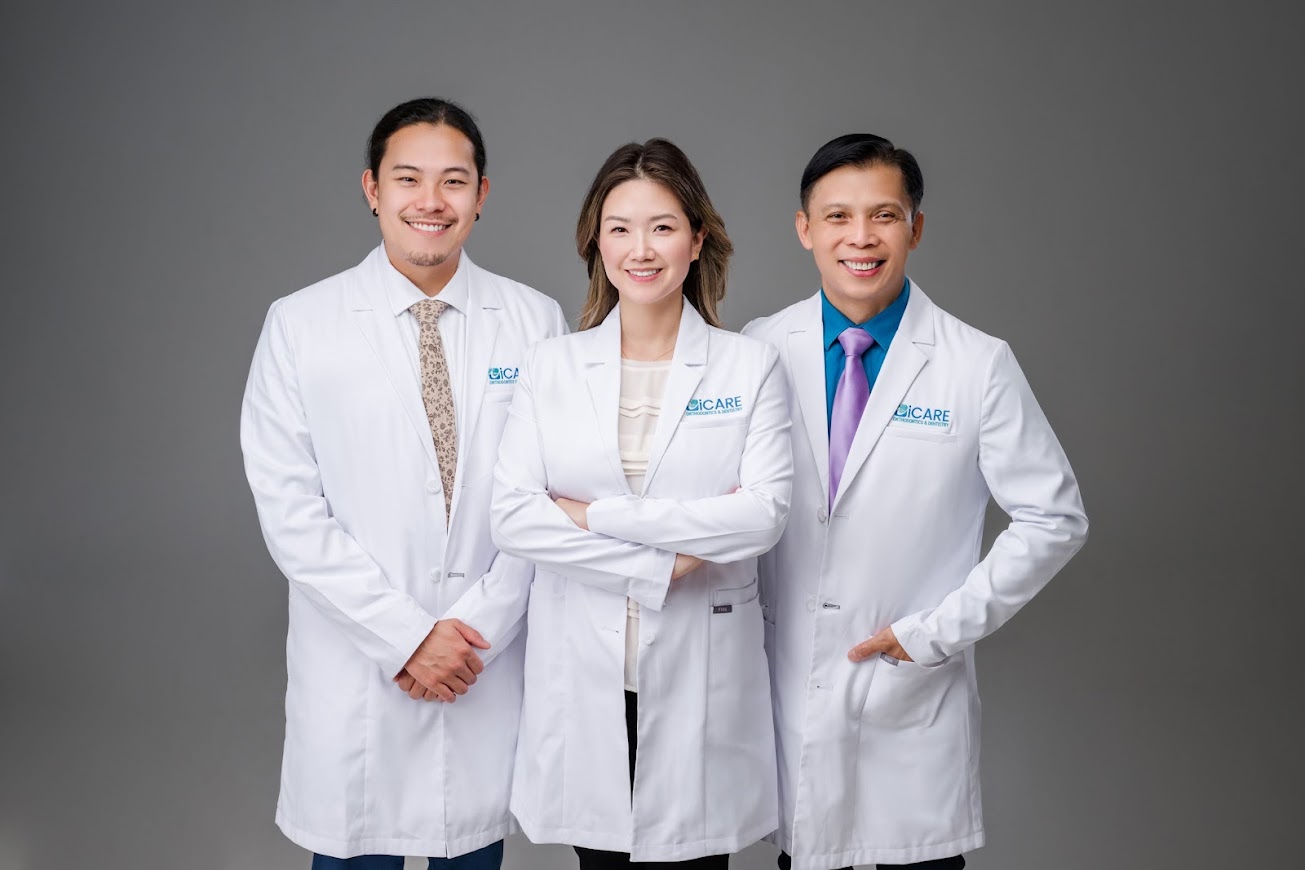
Every Invisalign case at iCare is planned and supervised by a board-certified orthodontist. Platinum status reflects consistent clinical case volume and documented outcomes recognized by Align Technology.
The Clear Aligner Landscape in 2026
There are two fundamentally different categories of clear aligner product. Understanding the difference matters before comparing individual brands.
Professional / In-Office Prescribed by a licensed orthodontist or dentist following a full in-person examination. Treatment planning, attachment placement and progress monitoring happen in a clinical setting. Examples: Invisalign, Spark, ClearCorrect, SureSmile.
Direct-to-Consumer / Mail-Order Treatment begins with photos or home impressions; no in-person exam required. A remote reviewer approves the case and aligners are shipped directly to the patient. Examples: Byte, Candid (partially), SmileDirectClub (now defunct).
| Brand | Category | Supervision | Case Range | Typical Cost | Status |
|---|---|---|---|---|---|
| Invisalign | Professional | In-person orthodontist or dentist | Mild to complex comprehensive | $3,000 to $10,000 | Active (market leader) |
| Spark | Professional | In-person orthodontist or dentist | Mild to comprehensive | $3,000 to $8,500 | Active, growing |
| ClearCorrect | Professional | In-person dentist or orthodontist | Mild to moderate | $2,500 to $6,000 | Active |
| SureSmile | Professional | In-person orthodontist | Mild to comprehensive | $3,000 to $7,500 | Active |
| Byte | DTC / Remote | Remote only (app/photos) | Mild cosmetic only | $1,895 to $2,295 | Active, limited |
| Candid | Hybrid | Partial in-person, remote review | Mild to moderate | ~$2,400 | Active |
| SmileDirectClub | DTC / Remote | Remote only | Mild cosmetic only | ~$2,000 | Shut down Dec. 2023 |
Invisalign: The Clinical Benchmark
Invisalign was the first clear aligner system, FDA-cleared in 1998. The clinical record it has accumulated over 26 years is unmatched by any other aligner brand.
Treatment is documented across every major orthodontic condition type: 372,000+ Class II cases, 1.53+ million deep bite cases, 97,000+ open bite cases and 233,000 extraction cases. Published in the American Journal of Orthodontics and Dentofacial Orthopedics, Seminars in Orthodontics, the Journal of Clinical Orthodontics and other peer-reviewed journals. The research base is the primary reason iCare uses Invisalign. At 800+ peer-reviewed publications, it is a documented record no other aligner system currently equals.
Spark Aligners: A Professional Competitor
Spark is the most clinically serious alternative to Invisalign currently on the market. Made by Ormco (a subsidiary of Envista Holdings), Spark is a professional-only system: prescribed and managed by licensed orthodontists and dentists following in-person examinations, uses attachments and elastics for complex tooth movements and is compatible with digital intraoral scanners including iTero.
What Spark Does Well
TruGEN and TruGEN XR material. Spark's aligner plastic is marketed as clearer and more stain-resistant than Invisalign's SmartTrack. The TruGEN material is trimmed to the gingival margin rather than scalloping around each tooth individually, a design difference Ormco argues produces a more aesthetic and comfortable fit. Independent patient experience comparisons have been mixed on this claim.
Comprehensive case capability. Spark is designed for the same case range as Invisalign: full arch alignment, bite correction including Class II and Class III, crossbites, open bites and extraction cases. It is not a cosmetic-only product.
Scanner compatibility. Spark integrates with both iTero and 3Shape Trios scanners, giving providers flexibility in their workflow.
Where Spark Differs from Invisalign
Clinical evidence base. This is the most significant difference. Invisalign has 800+ peer-reviewed publications and 26 years of documented outcomes. Spark launched in 2019 and its published clinical evidence base is substantially smaller. Orthodontists who choose Spark are drawing on Ormco's general aligner research and manufacturer data, not an independent peer-reviewed body of evidence comparable to Invisalign's.
Treatment simulation software. Invisalign uses ClinCheck, the most widely used orthodontic treatment planning software in clear aligner practice, refined over two decades. Spark uses its own Approver software. Both are capable tools; ClinCheck has the longer track record and a larger provider community generating refinement data.
Provider volume and refinement data. With 22 million cases completed, the data informing Invisalign's predictive algorithms draws on an enormous real-world case base. Spark's algorithm is newer and drawing from a smaller completed-case database.
For patients treated by an experienced orthodontist who has trained specifically with Spark, it is a professionally supervised system with genuine comprehensive case capability. It is not in the same clinical risk category as mail-order aligners. iCare uses Invisalign because its evidence base, refinement track record and clinical tools are unmatched at this time.
ClearCorrect: Professional but Limited
ClearCorrect was founded in 2006 and acquired by Straumann Group (a major dental implant company) in 2017. It is a professional system prescribed by licensed dentists and orthodontists following in-person exams, and is used by some practices as a lower-cost alternative for straightforward cases. ClearCorrect is also the aligner brand Candid uses for its hybrid model.
What ClearCorrect does well: Legitimate professional system with in-person examination required, Straumann's manufacturing and quality-control infrastructure, often priced lower than Invisalign at the provider level, and compatible with 3Shape Trios scanners.
ClearCorrect's limitations compared to Invisalign: Smaller published clinical evidence base, less sophisticated treatment planning software, fewer clinical tools for complex movements; SmartTrack's force profile has no equivalent in ClearCorrect's material, and the provider network depth is smaller. ClearCorrect treats mild to moderate cases well; for complex bite correction, comprehensive treatment or cases requiring precise torque control, Invisalign's toolset is more developed.
SureSmile: CBCT-Integrated Professional System
SureSmile (Dentsply Sirona) distinguishes itself by integrating with cone beam CT imaging for 3D root visualization in treatment planning. The clinical argument is that seeing root positions in 3D reduces the risk of collisions and root resorption during treatment. SureSmile is used exclusively in professional clinical settings, treats mild to comprehensive cases in experienced hands and has a smaller consumer brand presence than Invisalign or Spark. Its published clinical evidence base is limited compared to Invisalign's, and it is a niche product suited to practices with CBCT capability and SureSmile-trained providers.
What Happened to SmileDirectClub?
The aftermath matters for any patient evaluating DTC aligners:
- The New York Attorney General recovered $4.8 million for consumers wrongly charged after the shutdown.
- 77% of surveyed AAO member orthodontists reported seeing patients for retreatment after mail-order aligner treatment failed or caused new problems.
- AAO President Myron Guymon stated that because "most SmileDirectClub patients have not had an X-ray or in-person exam... an in-person exam with a licensed orthodontist" was the essential first step.
- The AAO formally noted that aligner movement without X-rays or bite analysis can produce "potentially irreversible and expensive damage such as tooth and gum loss, changed bites, and other issues."
Byte: Remote-Only Aligners
Byte is a remote-only aligner service. Patients receive an impression kit by mail, return their impressions and a remote reviewer approves the case. No in-person examination is required at any point.
What Byte addresses: Very mild cosmetic crowding or spacing in cases with no bite involvement, with a marketed typical treatment time of 3 to 5 months for appropriate cases.
Byte's fundamental limitations: No X-rays before treatment begins, meaning pre-existing bone loss, root abnormalities, impacted teeth and TMJ conditions are not identified. No bite analysis means bite problems introduced or worsened by treatment may not be caught until damage is done. No in-person monitoring means if tooth movement goes off-plan, there is no clinician present to intervene. Restricted to mild cosmetic cases only. HyperByte vibration device is marketed as an accelerator with limited independent long-term safety data.
For patients who have confirmed through an in-person exam that they have a straightforwardly mild cosmetic case with no underlying dental conditions, remote-only aligners may produce acceptable results. The problem is that confirming this requires the in-person exam the service does not require.
Candid: Hybrid Model
Candid has moved away from the fully remote model toward a hybrid approach, requiring a CandidPro scan at a partner scanning location. Cases are reviewed by orthodontists (remotely). Aligners used are ClearCorrect-manufactured. Typical cost is around $2,400 for mild to moderate cases. Candid does not offer full in-person orthodontist examination, X-rays or bite analysis, and there is no progress monitoring by a clinician who can adjust mid-course.
The SmartTrack Material Difference
Not all clear aligners are made from the same plastic. Generic and private-label aligner brands typically use single-layer PETG, a commodity material that loses corrective force relatively quickly after seating.
Invisalign's SmartTrack is a proprietary multilayer medical-grade polyurethane developed after testing more than 260 polymer formulations. The published clinical difference:
- SmartTrack achieves 73.1% of planned tooth movement by day 14
- The previous Invisalign material (EX30) achieved only 42.8% by day 14
- That is a 71% improvement in movement predictability from the material change alone
- SmartTrack maintains consistent force throughout the full two-week wear cycle rather than concentrating force in the first few days
Spark's TruGEN material is a competitor to SmartTrack, also a multi-layer engineered thermoplastic. Ormco claims similar force characteristics. Peer-reviewed head-to-head force comparison data between TruGEN and SmartTrack is limited; current published data favors SmartTrack given the depth of available research. PETG-based aligners (most generic and private-label brands) have no published data demonstrating comparable force delivery.
Professional vs. DTC: The Core Clinical Argument
Mail-order aligner services were built on the premise that orthodontic treatment is simple enough to administer without an in-person provider. The evidence from retreatment cases and the SmileDirectClub collapse suggests otherwise.
There are specific clinical findings that only an in-person examination with X-rays can identify, and that the DTC model systematically misses:
- Active bone loss: visible on X-ray, invisible to the naked eye or a photo
- Root abnormalities: roots that make certain movements unsafe
- Impacted teeth: can be disrupted by aligner pressure without any visible warning
- TMJ conditions: require treatment modification and cannot be diagnosed remotely
- Pre-existing gum disease: must be controlled before teeth are moved
None of these are visible in an at-home impression or a phone photograph. Every professional aligner system (Invisalign, Spark, ClearCorrect, SureSmile) requires an in-person examination before treatment. This is the line that separates the two categories.
Head-to-Head: Professional Aligner Systems
| Factor | Invisalign at iCare | Spark | ClearCorrect | SureSmile |
|---|---|---|---|---|
| In-person exam required | Yes | Yes | Yes | Yes |
| X-rays before treatment | Yes | Yes | Yes | Yes |
| Specialist oversight at iCare | Board-certified orthodontist | Board-certified orthodontist | Dentist or orthodontist | Orthodontist |
| Case complexity range | Mild to complex comprehensive | Mild to comprehensive | Mild to moderate | Mild to comprehensive |
| Aligner material | SmartTrack (multilayer polyurethane) | TruGEN (multilayer) | Proprietary plastic | Proprietary plastic |
| Peer-reviewed publications | 800+ (past 10 yrs) | Limited (newer system) | Limited | Very limited |
| Years on market | 26 (since 1998) | ~5 (since 2019 to 2020) | ~18 (since 2006) | ~15+ |
| Patients treated globally | 22 million+ | Not publicly disclosed | Millions (est.) | Not publicly disclosed |
| Treatment planning software | ClinCheck | Approver | ClearCorrect portal | SureSmile |
| Typical cost range | $3,000 to $10,000 | $3,000 to $8,500 | $2,500 to $6,000 | $3,000 to $7,500 |
Head-to-Head: Professional vs. DTC Systems
| Factor | Invisalign at iCare | Byte | Candid | SmileDirectClub |
|---|---|---|---|---|
| In-person exam | Yes, by orthodontist | No | Scan only (remote review) | No |
| X-rays before treatment | Yes | No | No | No |
| Orthodontist oversight | Board-certified specialist | No | Remote orthodontist review | No |
| Case complexity range | Mild to complex comprehensive | Mild cosmetic only | Mild to moderate | Mild cosmetic only |
| In-person progress monitoring | Every 8 to 12 weeks | None | None | None |
| Emergency response | In-person same-week | Remote / app | Remote | N/A (closed) |
| Insurance coverage | Yes (PPO) | Rarely | Rarely | N/A (closed) |
| Published clinical evidence | 800+ peer-reviewed | Minimal | Minimal | None |
| Company status | Active, 26 years | Active | Active | Shut down Dec. 2023 |
| Typical cost | $3,000 to $10,000 | $1,895 to $2,295 | ~$2,400 | N/A |
The Real Cost of Cheaper Aligners
The price gap between Invisalign and alternatives looks significant on paper. The calculation changes when retreatment is factored in. 77% of AAO orthodontists have seen patients for retreatment after mail-order aligner treatment failed. These patients paid around $2,000 for remote aligners, experienced new bite problems or gum recession, and then paid again for in-office correction. In many cases the total spend exceeded what Invisalign with an orthodontist would have cost from the start.
For professional alternatives like Spark and ClearCorrect, the cost comparison is closer, but the question is which clinical toolset and which evidence base is managing the case. iCare's recommendation to use Invisalign is based on the evidence record, not price differentiation.
Non-dollar costs of unmonitored treatment that the AAO formally documents as "potentially irreversible and expensive":
- Root resorption that does not reverse
- Gum recession requiring grafting
- Bite changes requiring restorative correction
- Permanent TMJ effects
Why iCare Uses Invisalign
iCare is a Platinum Invisalign Provider, Align Technology's recognition for consistent clinical case volume and documented outcomes. The decision to offer Invisalign rather than Spark, ClearCorrect or another professional system comes down to one factor: the evidence base.
At 800+ peer-reviewed publications, 22 million patients treated and 26 years of clinical refinement, Invisalign provides a foundation that allows Dr. Jamie Kim and Dr. Vinh Huynh to make case decisions grounded in published data rather than manufacturer claims alone. Spark is a credible competitor that iCare monitors; if its evidence base develops further and outcomes data matures, that assessment may evolve. As of 2026, Invisalign's clinical record is the deepest in the industry.
iCare does not offer mail-order or remote-only aligners. Every orthodontic patient begins with a full in-person examination, appropriate radiographic records and a treatment plan designed by a board-certified orthodontist. That is a standard, not an upsell.
Frequently Asked Questions: Invisalign vs. Other Clear Aligners
Is Invisalign better than Spark?
Invisalign and Spark are both professional in-office systems: both require in-person examination, both treat comprehensive cases and both use engineered multilayer aligner materials. The meaningful difference is clinical evidence depth. Invisalign has 800+ peer-reviewed publications over 26 years and 22 million documented patient outcomes. Spark launched in 2019 to 2020 and has a substantially smaller published evidence base. For a practice committed to evidence-based treatment, Invisalign's research foundation is the deciding factor. Spark is a serious competitor, not in the same risk category as mail-order brands, but its clinical literature is still developing.
How does Invisalign compare to ClearCorrect?
ClearCorrect is a legitimate professional aligner system used by licensed dentists and orthodontists. It treats mild to moderate cases adequately and is often priced lower. It lacks the clinical evidence depth, treatment planning sophistication and complex case toolset of Invisalign. For straightforward mild cases, the difference may be minimal. For bite correction, complex crowding or any case requiring precise torque control, Invisalign's more developed system has advantages.
What is the difference between professional and mail-order aligners?
The defining difference is whether an in-person clinical examination and X-rays occur before treatment begins. Professional systems (Invisalign, Spark, ClearCorrect, SureSmile) require this. Mail-order systems (Byte, formerly SmileDirectClub) bypass the in-person exam entirely. This matters because orthodontic tooth movement without identifying pre-existing bone loss, root abnormalities, impacted teeth or bite issues can cause irreversible harm. The AAO has formally documented this risk.
What happened to SmileDirectClub?
SmileDirectClub filed for Chapter 11 bankruptcy in October 2023 and shut down completely in December 2023, leaving tens of thousands of patients stranded mid-treatment with no access to their records or ongoing care. The New York Attorney General recovered $4.8 million for consumers wrongly charged after the closure. The AAO advised all affected patients to seek in-person evaluations with licensed orthodontists.
Does insurance cover Invisalign but not other aligner brands?
Most PPO orthodontic insurance plans cover Invisalign when prescribed by a licensed orthodontist or dentist in a clinical setting. Coverage for Spark and ClearCorrect depends on the specific plan; some plans cover any professionally supervised aligner system; others name Invisalign specifically. Mail-order aligner services are generally not covered by dental insurance. iCare verifies your specific plan's terms before treatment begins.
Is Invisalign the best clear aligner?
By the metrics most relevant to clinical outcomes (published evidence, case range, material technology and treatment planning maturity), Invisalign has the strongest documented record. 800+ peer-reviewed publications, 22 million patients treated and 26 years of refinement represent a foundation no other clear aligner system currently matches. Spark is the most credible professional competitor and its evidence base is growing.
How do I know which aligner system is right for me?
A board-certified orthodontist determines this at a full clinical examination, reviewing your teeth, bite, X-rays and jaw function. There is no way to know from a photo, a website quiz or a home impression. At iCare, that evaluation is free and carries no obligation.
Clear aligner consultation near Duluth, Peachtree Corners and Norcross
iCare provides free consultations for patients from Norcross, Duluth, Peachtree Corners, Lilburn, Tucker, Suwanee, Johns Creek and throughout Gwinnett County. If you are evaluating clear aligner options and want a clinical opinion from a board-certified orthodontist, we are at 1568 Indian Trail Lilburn Rd., Ste. 201, Norcross, GA 30093.
 Braces
 Insurance & Financing
Invisalign and SmartTrack are trademarks of Align Technology, Inc. Spark and TruGEN are trademarks of Ormco Corporation. ClearCorrect is a trademark of Straumann Group. Byte and Candid are independent companies. None of these brands are affiliated with iCare Orthodontics & Dentistry.