
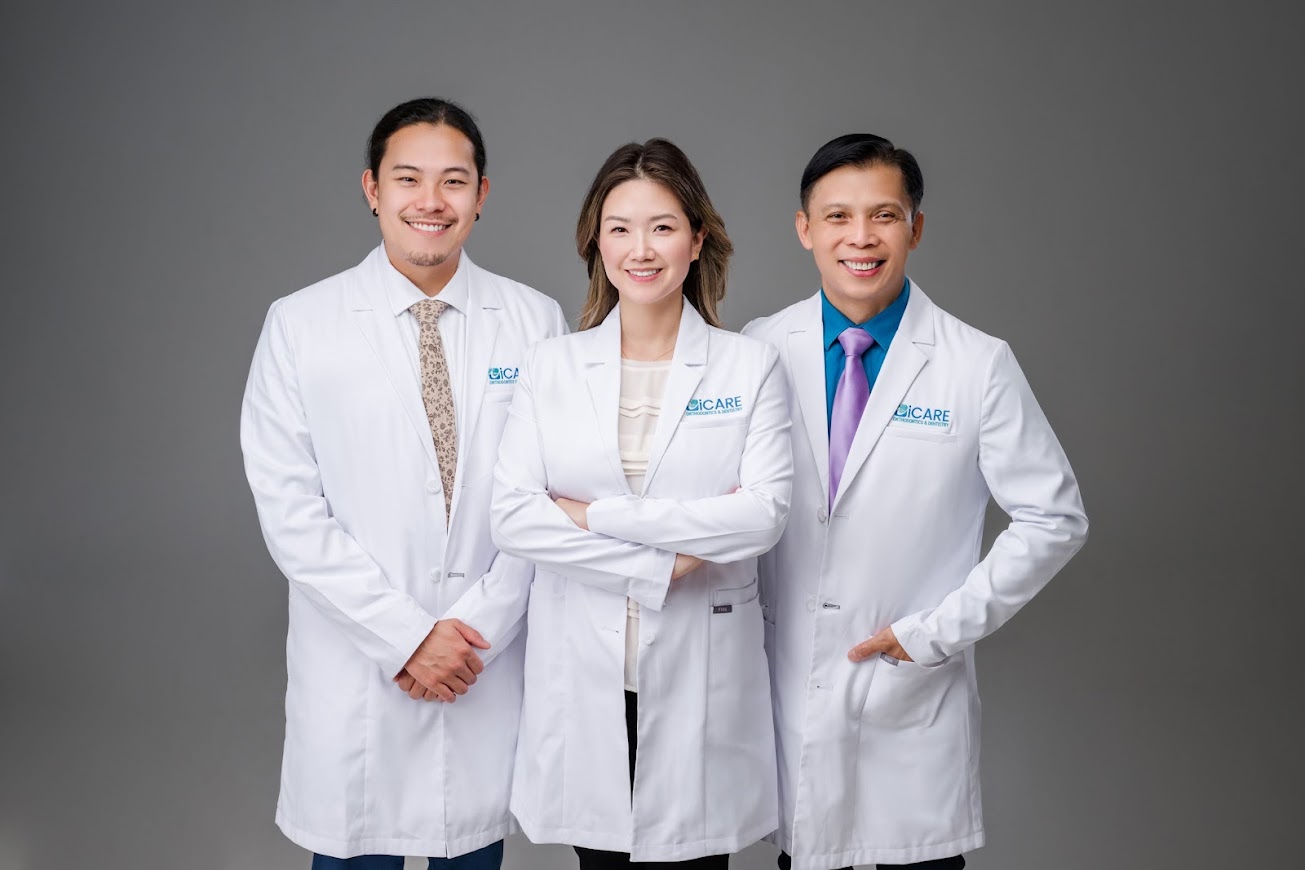
 Norcross, GA
Invisalign is a system of custom-made, removable clear plastic aligners that gradually move teeth into their target positions. Each aligner in the series shifts teeth a precise, pre-planned amount: typically a fraction of a millimeter, until the full treatment sequence is complete. Since FDA clearance in 1998, Align Technology has treated more than 22 million patients worldwide, backed by over 800 peer-reviewed scientific publications. That makes Invisalign the most clinically documented clear aligner system available. At iCare in Norcross, GA, Invisalign treatment is planned by board-certified orthodontists using the same diagnostic rigor applied to braces cases.
How Does Invisalign Work?
Invisalign works through a series of custom-fabricated plastic aligner trays. Each tray is worn for approximately one to two weeks, exerting controlled, gentle pressure on specific teeth to move them in the direction prescribed by the treatment plan. The trays are replaced in sequence: each one slightly different from the last, until the teeth arrive at their final positions.
SmartTrack® Aligner Material
Align Technology's proprietary thermoplastic was selected after testing more than 260 polymer formulations. The engineering goal was a material that delivers consistent force over the full wear cycle, not just at tray insertion. Independent research comparing SmartTrack to the prior EX30 material found SmartTrack achieves 73.1% of planned tooth movement by day 14, versus 42.8% for the previous material. That difference translates directly into more predictable tooth movement per tray, fewer unexpected deviations from the treatment plan and, in practice, a shorter overall treatment course.
SmartTrack is BPA-free, thin enough to be nearly invisible and smooth enough to avoid irritating the soft tissues of the cheeks and lips.
Precision Attachments
For movements that require extra grip: rotations, extrusions, certain torque corrections, small tooth-colored composite shapes called attachments are bonded directly to teeth. They serve as handles for the aligner to engage, significantly expanding the range of tooth movement possible with clear aligners. Attachment design is determined by the orthodontist during ClinCheck treatment planning.
Elastics
Some cases, particularly those involving bite correction, use elastics with Invisalign in the same way they are used with braces. Small precision-cut hooks on the aligner accommodate elastics that correct overbites, underbites and midline discrepancies. Align Technology has treated more than 1.53 million deep bite patients globally using bite ramp technology built into aligner design.
iTero® Digital Scanning
At iCare, treatment planning begins with an iTero intraoral scan: a contactless, impression-free digital map of the full bite. The iTero Element 5D and Lumina models achieve 0.04% trueness and 0.032% precision, accuracy that far exceeds traditional dental impressions. The scan feeds directly into ClinCheck software, where the orthodontist designs the full tooth movement sequence before any aligner is produced. Patients see a projected 3D simulation of their outcome at the same appointment.
The Clinical Record Behind Invisalign
Before committing to any treatment, it is reasonable to ask: what does the evidence show?
Align Technology's clinical evidence program includes citations to more than 800 peer-reviewed publications across orthodontic, dental and biomedical journals. Key findings across the research base include:
- Periodontal health: Multiple studies confirm Invisalign patients show significantly lower plaque index scores and less gingival bleeding than patients in fixed braces, a finding attributed to the ability to remove aligners for normal brushing and flossing.
- Root resorption: A study by Gu et al. (2017) found statistically significantly less root resorption in Invisalign patients compared to braces, an important long-term consideration for tooth health.
- Treatment time: A peer-reviewed comparison found Invisalign treatment completed 5 to 5.5 months faster than fixed braces for equivalent Class I cases.
- Appointment frequency: Invisalign patients typically require 30% fewer clinical appointments than braces patients over the same treatment course.
- Class II cases: Align Technology has documented treatment outcomes across more than 372,000 Class II (overbite) cases globally using clear aligners.
The depth of this research base is one meaningful distinction between Invisalign and direct-to-consumer aligner alternatives, most of which have no published peer-reviewed clinical outcomes data.
What Can Invisalign Treat?
Invisalign addresses a wide range of orthodontic conditions. Modern aligner technology, combined with attachments and elastics, has expanded treatable case complexity significantly since the first aligners were cleared by the FDA in 1998.
Crowding: When teeth overlap due to insufficient arch space. Invisalign moves teeth progressively to create space and alignment without extractions in many cases.
Spacing: Gaps between teeth, including diastemas (gaps between front teeth) and generalized spacing throughout the arch.
Overbite: When the upper front teeth overlap too far in front of the lower front teeth vertically. Aligners with elastics and bite ramps address many overbite cases. With over 1.53 million treated deep bite patients, this is one of Invisalign's most validated treatment categories.
Underbite: When the lower teeth protrude in front of the upper teeth. Mild to moderate underbites can often be addressed with aligners and elastics. Severe skeletal underbites may require surgical intervention alongside orthodontic treatment.
Crossbite: When upper and lower teeth bite on the wrong side of each other. Both anterior (front) and posterior (back) crossbites are within Invisalign's documented treatment range.
Open Bite: When upper and lower front teeth do not overlap or touch when the back teeth are closed together. Anterior open bites respond well to aligner therapy in mild to moderate presentations.
Mild Relapse After Previous Treatment: Adults who have seen post-treatment shifting since completing earlier orthodontic treatment are among the most predictable Invisalign candidates, often requiring shorter treatment courses.
What Invisalign May Not Handle Alone: Severe skeletal discrepancies, significant vertical issues, impacted teeth or complex multi-disciplinary cases may require traditional braces, orthopedic appliances, surgical orthodontics or a combined approach. A board-certified orthodontist at iCare confirms whether aligners are the clinically appropriate tool for your specific presentation.
Invisalign vs. Braces: Honest Comparison
| Factor | Invisalign | Traditional Braces |
|---|---|---|
| Visibility | Nearly invisible | Metal or ceramic brackets |
| Removable | Yes: for meals and hygiene | No: bonded to teeth |
| Diet | No restrictions | Avoid hard, sticky foods |
| Hygiene | Brush and floss normally; lower plaque index (research-documented) | Requires extra cleaning effort around brackets |
| Comfort | Smooth plastic, no wires | Possible wire pokes, bracket irritation |
| Root resorption risk | Lower (Gu et al. 2017) | Higher |
| Treatment time | ~5 to 5.5 months faster for equivalent cases | Standard timeline |
| Compliance | Patient must wear 20 to 22 hrs/day | No compliance variable: always working |
| Appointments | Every 8 to 12 weeks (~30% fewer) | Every 4 to 8 weeks |
| Complex cases | Mild to moderate ideal; Class II, deep bite documented | All complexity levels |
| Cost at iCare | Comparable | Comparable |
The right choice depends entirely on the patient's case. At iCare, orthodontists recommend the treatment that produces the best clinical result for each individual, not the one that is easier to sell.
The Invisalign Treatment Timeline
-
Free Consultation
A board-certified orthodontist reviews your teeth, bite, growth stage and goals. No cost, no obligation. You receive a clear assessment of whether Invisalign is right for your case and what the alternative options are.
-
iTero Digital Scan
A contactless, impression-free intraoral scan creates a precise 3D model of your bite in minutes. Accuracy at 0.04% trueness: more precise than traditional impressions.
-
Orthodontist-Designed ClinCheck Plan
Your orthodontist maps the complete sequence of tooth movements in 3D software. You see an animated preview of the projected outcome before committing to treatment. Every plan at iCare is designed and approved by a specialist.
-
Aligner Fabrication
Align Technology manufactures your custom series of SmartTrack aligner trays. Fabrication typically takes two to three weeks after the final treatment plan is approved.
-
Delivery and Attachment Placement
At your delivery appointment, the orthodontist seats you, bonds any attachments needed, confirms fit and reviews wear and care instructions. Most patients leave wearing their first set of aligners.
-
Progress Checks Every 8 to 12 Weeks
Periodic appointments: approximately 30% fewer than braces. These verify tooth movement, assess bite development and deliver the next batch of trays. SmartTrack's 73.1% predictability rate at day 14 means these checks typically confirm the teeth are tracking as planned.
-
Refinements (if needed)
After the main aligner series, some cases require refinement trays to fine-tune final tooth positions. Refinements are common and are typically included in the original fee at iCare.
-
Retainers and Retention
Active treatment ends; retention begins. Retainers are worn to hold the corrected positions long-term. Your orthodontist reviews a retention wear schedule at the final active visit.
What Is a Platinum Invisalign Provider?
Invisalign's provider recognition program, maintained by Align Technology, tracks case volume and clinical documentation across all providers globally. The Platinum level reflects a consistent record of Invisalign case starts and demonstrated case management expertise. iCare holds Platinum Provider status through Align Technology.
More importantly: every case at iCare is planned by a board-certified orthodontist. Orthodontists complete two to three additional years of specialist residency training beyond dental school, focused specifically on tooth movement, bite development, jaw relationships and facial growth. Many Invisalign providers in Georgia are general dentists. Some produce excellent results, but specialist oversight adds a layer of clinical rigor that is especially meaningful in complex cases, growing patients and cases requiring bite correction alongside alignment.
When evaluating any Invisalign provider, it is worth asking: who designs the treatment plan? At iCare, the answer is always a board-certified orthodontist.
How Much Does Invisalign Cost?
At iCare, Invisalign fees typically range from $3,000 to $10,000 depending on case complexity, from limited Lite cases on the low end to complex comprehensive bite correction cases at the high end. Most PPO orthodontic insurance plans apply their lifetime benefit to Invisalign at the same amount they apply to braces. Interest-free in-house financing is available directly through iCare.
Full pricing breakdown and insurance information →
Frequently Asked Questions: What Is Invisalign?
Is Invisalign as effective as braces?
For the cases it is designed to treat, yes. Align Technology's database of over 800 peer-reviewed publications documents equivalent or superior outcomes for mild to moderate crowding, spacing and many bite problems when treatment is planned by a skilled orthodontist. Peer-reviewed studies also show shorter treatment times and fewer clinical visits for Invisalign versus braces in comparable cases. For more complex tooth movements or severe skeletal discrepancies, braces remain the more controlled option. Your orthodontist makes that call after a full evaluation.
Is Invisalign FDA-approved?
Yes. Invisalign clear aligners were cleared by the U.S. Food and Drug Administration in 1998 as a Class II medical device for use in correcting malocclusion. Current SmartTrack aligner material is FDA-cleared. The iTero scanner used for treatment planning is also FDA-cleared as a dental intraoral scanner.
How is Invisalign different from mail-order clear aligners?
Mail-order aligners (marketed by companies like Byte and formerly SmileDirectClub) do not involve an in-person orthodontist exam, diagnostic X-rays or professional supervision during treatment. Invisalign requires a licensed dental professional to prescribe, plan and oversee treatment. The American Association of Orthodontists has issued formal statements documenting cases of bite damage, root resorption and permanent harm from unsupervised aligner use. SmileDirectClub filed for Chapter 11 bankruptcy in October 2023 and ceased operations in December 2023.
Does Invisalign use real teeth impressions?
At iCare, no. The iTero scanner creates a digital impression with no putty, no trays and no gagging. The scan takes a few minutes and produces a more accurate 3D model at 0.04% trueness and 0.032% precision than traditional physical impressions.
Are there food restrictions with Invisalign?
No. Aligners are removed for every meal and snack. You eat and drink normally throughout treatment. The only guideline: nothing but water while aligners are in place, to avoid staining the trays or trapping sugars against teeth.
What is SmartTrack material and why does it matter?
SmartTrack is Align Technology's proprietary aligner plastic, selected after testing more than 260 polymer formulations. Research shows it achieves 73.1% of planned tooth movement by day 14 of each wear cycle, versus 42.8% for the prior generation material. For patients, this translates to more predictable tooth movement per tray, better fit and fewer unexpected deviations from the planned result.
Can Invisalign fix a bite problem, not just crooked teeth?
Yes. Overbites, underbites, crossbites and open bites are routinely addressed with Invisalign, often using precision attachments and elastics. Align Technology has documented outcomes for over 1.53 million deep bite patients and more than 372,000 Class II cases globally. Severe skeletal bites may require surgical collaboration alongside orthodontic treatment. Your orthodontist confirms the right approach at your consultation.
What is ClinCheck® software?
ClinCheck is Align Technology's 3D treatment planning and simulation software. Your orthodontist uses it to design each step of tooth movement, mapping the full trajectory from start to finish, and to generate the animation you see at your consultation showing your projected outcome. Every case at iCare is designed in ClinCheck by a board-certified orthodontist before any aligners are produced.
Who makes Invisalign and how long has it been available?
Invisalign is manufactured by Align Technology, Inc., founded in 1997 by Zia Chishti and Kelsey Wirth. The first aligners were FDA-cleared in 1998. As of 2024, Align Technology has treated more than 22 million patients globally and has expanded the system's treatable case range significantly from its original indication of mild crowding.
Clear Aligner Treatment in Norcross, GA
iCare is located at 1568 Indian Trail Lilburn Rd., Ste. 201, Norcross, GA 30093, serving patients from Norcross, Duluth, Peachtree Corners, Lilburn, Tucker, Suwanee, Johns Creek and throughout Gwinnett County.
Invisalign, SmartTrack, ClinCheck, iTero and the Invisalign logo are trademarks of Align Technology, Inc., registered in the U.S. and other countries.